
Lofted Trajectory: 3D-Printed CEMENT Public Art.
A New Landmark at Xinhua Golf Course
Located at the course entrance, Lofted Trajectory by Yu-Jung Chen features an eagle-headed golfer, translating the focus, power, and flight of golf into a striking three-dimensional form.
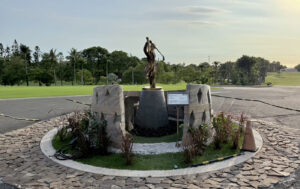
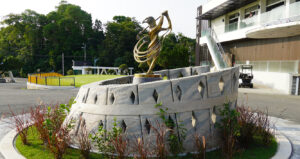
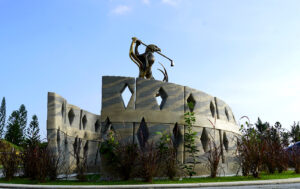
▶The base of 《Lofted Trajectory》 is not merely a structural support for the sculpture. It is an integral part of the artwork’s overall design language.|Tainan Golf Club
A Spatial Trajectory Extended from the Golf Swing
At the visual center of the artwork is an eagle-headed human figure.
The eagle symbolizes protection, courage, and flight, while the figure’s golf swing represents the focus, precision, and pursuit of self-transcendence associated with the sport. The wings, body, and golf club extend outward to form a sweeping arc, resembling the path of a golf ball soaring across the sky.
This arc is more than a decorative element. It guides the viewer’s gaze upward from the ground, creating a strong visual focal point at the golf course entrance with a clear sense of direction, movement, and speed.
Information
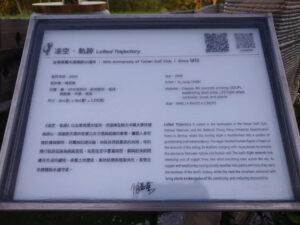
Title| Lofted Trajectory
English Title| LOFTED TRAJECTORY
Year| 2026
Location| Entrance of Tainan Golf Club / Xinhua Golf Course
Artwork Design| Designer Yu-Jung Chen, Zhongsheng Creative Studio
3D Concrete Printing| Everplast
Dimensions| Approx. 6 m × 6 m × 2.85 m
Primary Materials| Copper, 3D-printed concrete, weathering steel plates, LED light strips, control system, wood, and landscaping plants
▶ Source: Designer Yu-Jung Chen, Zhongsheng Creative Studio
How Is 3D-Printed Cement Used in Public Art?
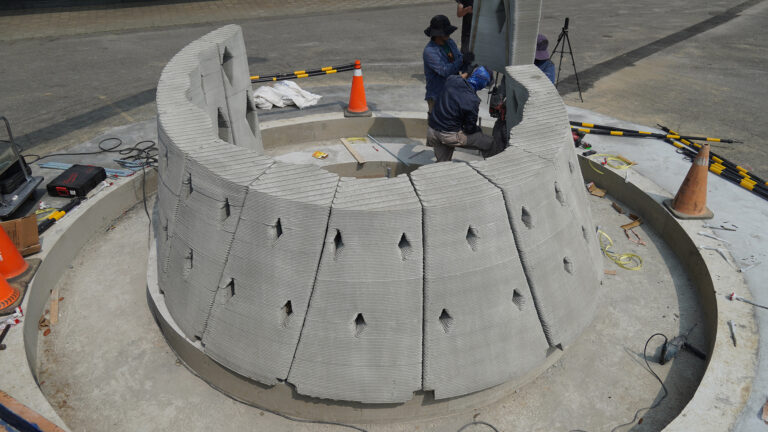
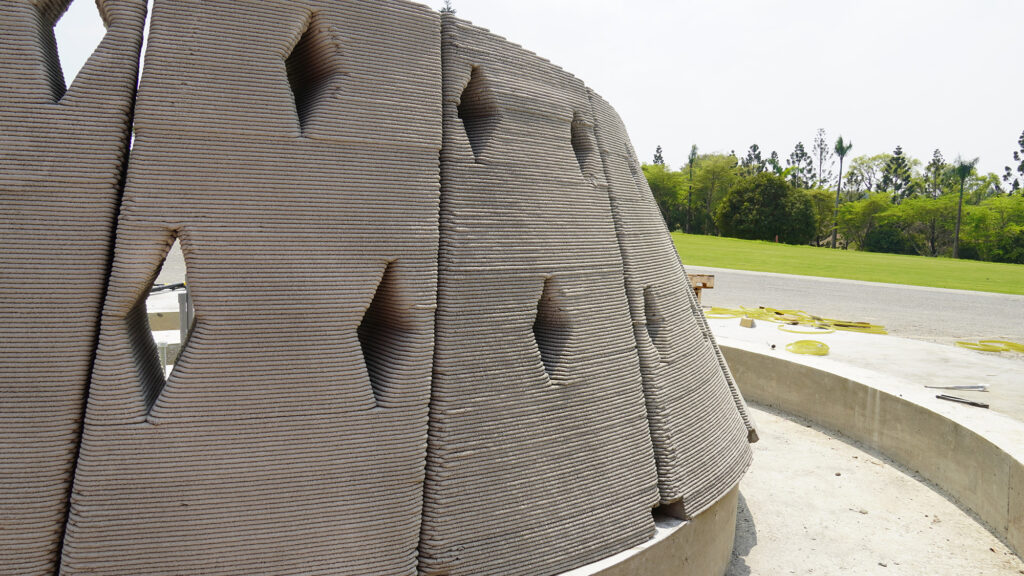
Everplast used a large-scale cement 3D printer to deposit material layer by layer based on a digital model developed through parametric design. This approach allowed the geometry, surface flow, and printing path to be precisely coordinated, creating a continuous, organic form with a clear directional quality. Compared with conventional formwork, cement 3D printing enables irregular curves and free-form geometries to be produced more directly, reducing the limitations imposed by standard molds.
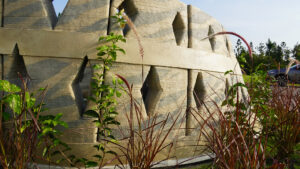
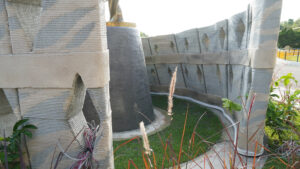
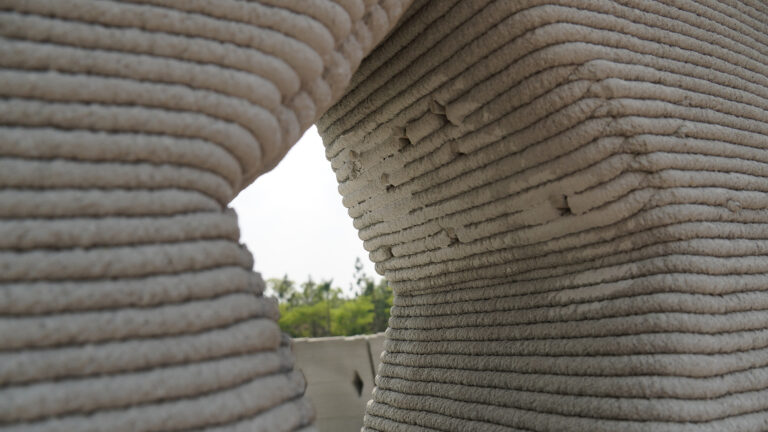
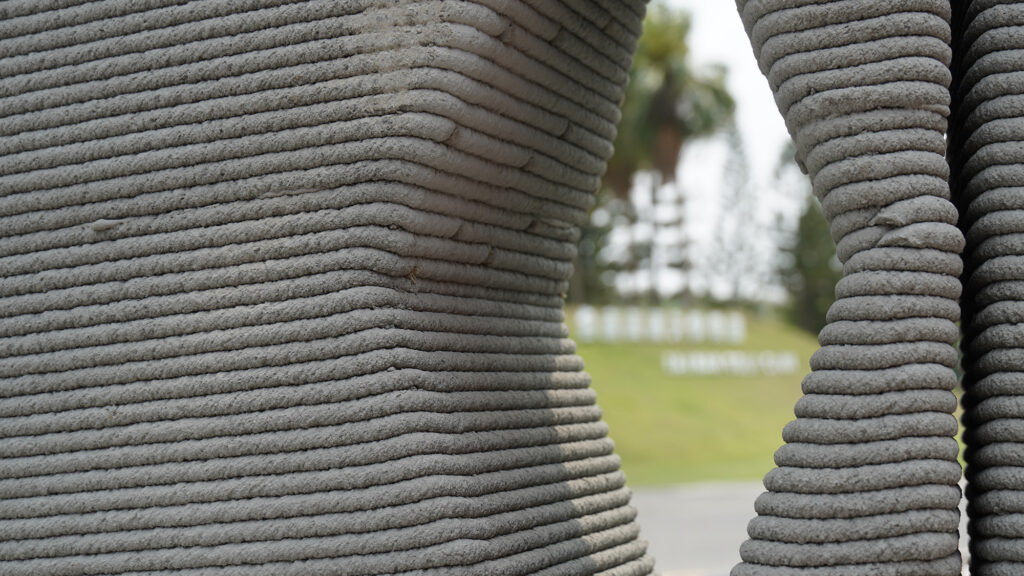
The printed layer lines on the base were deliberately preserved. Viewed from different angles, the textures resemble both the layered structure of an eagle’s nest and a landscape gradually emerging from the earth.
Where Digital Fabrication Meets Hand-Finished Craftsmanship
Lofted Trajectory does not hide the technology behind its creation.
The layered texture of the 3D-printed concrete, the patinated surfaces of the metal components, the hand-applied finishes, and the surrounding vegetation are all presented as visible and tangible elements of the work.
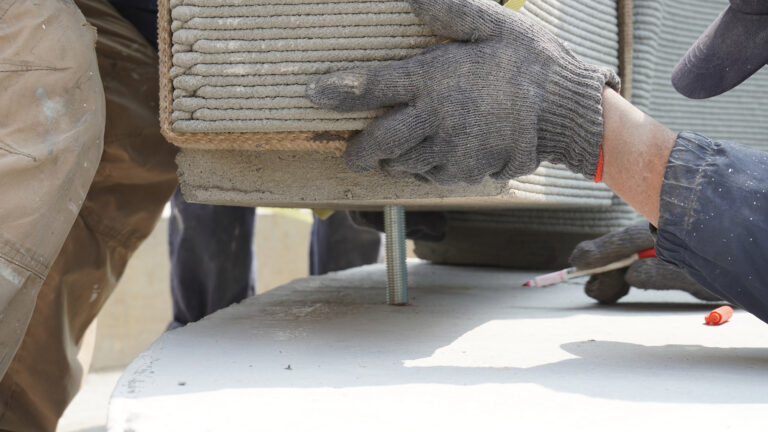
Digital fabrication transforms complex geometry and design models into physical form, while the artist’s sculptural decisions, surface testing, and on-site landscape arrangement give the work emotional depth and local meaning.
Technology and craftsmanship do not replace one another. Instead, they work together within the same public artwork to shape form, material, time, and environment.
Creating a Recognizable Landmark at the Golf Course Entrance
Public art must not only communicate a creative concept but also respond to the physical conditions of its site.
Installed at the entrance of Xinhua Golf Course, Lofted Trajectory was designed to maintain a clear silhouette when viewed from a distance while also revealing detailed material textures at close range.
The upward movement of the sculpture creates a strong visual identity for the entrance, while the broad arc allows the work to be seen from multiple approach directions. The base and surrounding planting form an integrated landscape, helping the large-scale sculpture connect naturally with the road, golf course, and surrounding environment.
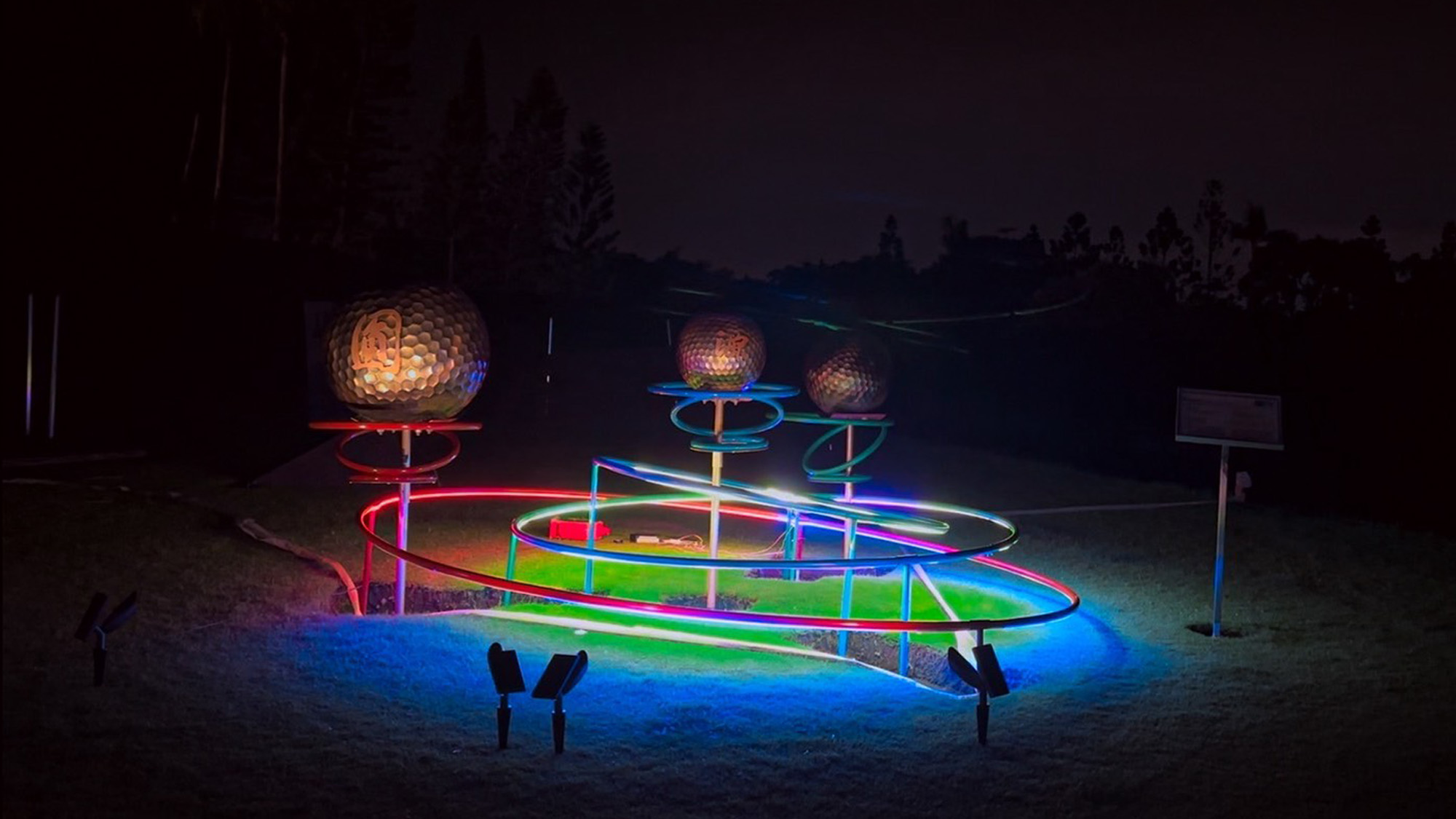
At night, integrated lighting further defines the sculpture’s silhouette, metal arc, and layered concrete base, allowing the artwork to reveal a different character after dark.
Q&A
What Was Everplast Responsible for in This Project?
Everplast produced the 3D-printed cement base beneath the artwork. By integrating parametric design, the design model was converted into executable printing paths, allowing precise control over the surface geometry, layer direction, and material deposition. The base was then formed through a layer-by-layer additive process, creating a concrete structure with organic curves, directional form, and distinctive digital layer textures.
Why Use 3D-Printed Cement for a Public Art Base?
Cement 3D printing can produce free-form surfaces and non-standard geometries directly from a digital model. It reduces the limitations of conventional molds and formwork while allowing the printed textures to remain visible as part of the artwork. This makes the technology particularly suitable for highly customized public art and landscape elements.
Do the Layer Lines of 3D-Printed Cement Need to Be Smoothed?
Not necessarily. Depending on the design requirements, the printed layers can be preserved, partially refined, or finished with coatings. For 《Lofted Trajectory》, the layered texture of the base was intentionally retained, creating a visual effect reminiscent of an eagle’s nest or a structure emerging naturally from the earth.
Can Large-Scale 3D Printing Work with Models Provided by Artists or Designers?
Yes. Everplast can evaluate 3D models provided by the design team, including their dimensions, materials, printing orientation, segmentation, structural requirements, and assembly conditions. Based on this assessment, Everlast can then develop a suitable production process.